Beaconia Well Changes

    The RM of St. Clements continues to address the issues surrounding the Beaconia Well, following recent regulatory updates and the issuance of a well sealing order. We want to ensure that our residents are fully informed about the status of this vital water system and the steps we are taking to comply with provincial regulations.

    Overview

    As part of our commitment to enhancing communication with residents by embracing innovative, information delivery methods. Below are AI generated videos of the information provided on this website.

    Background

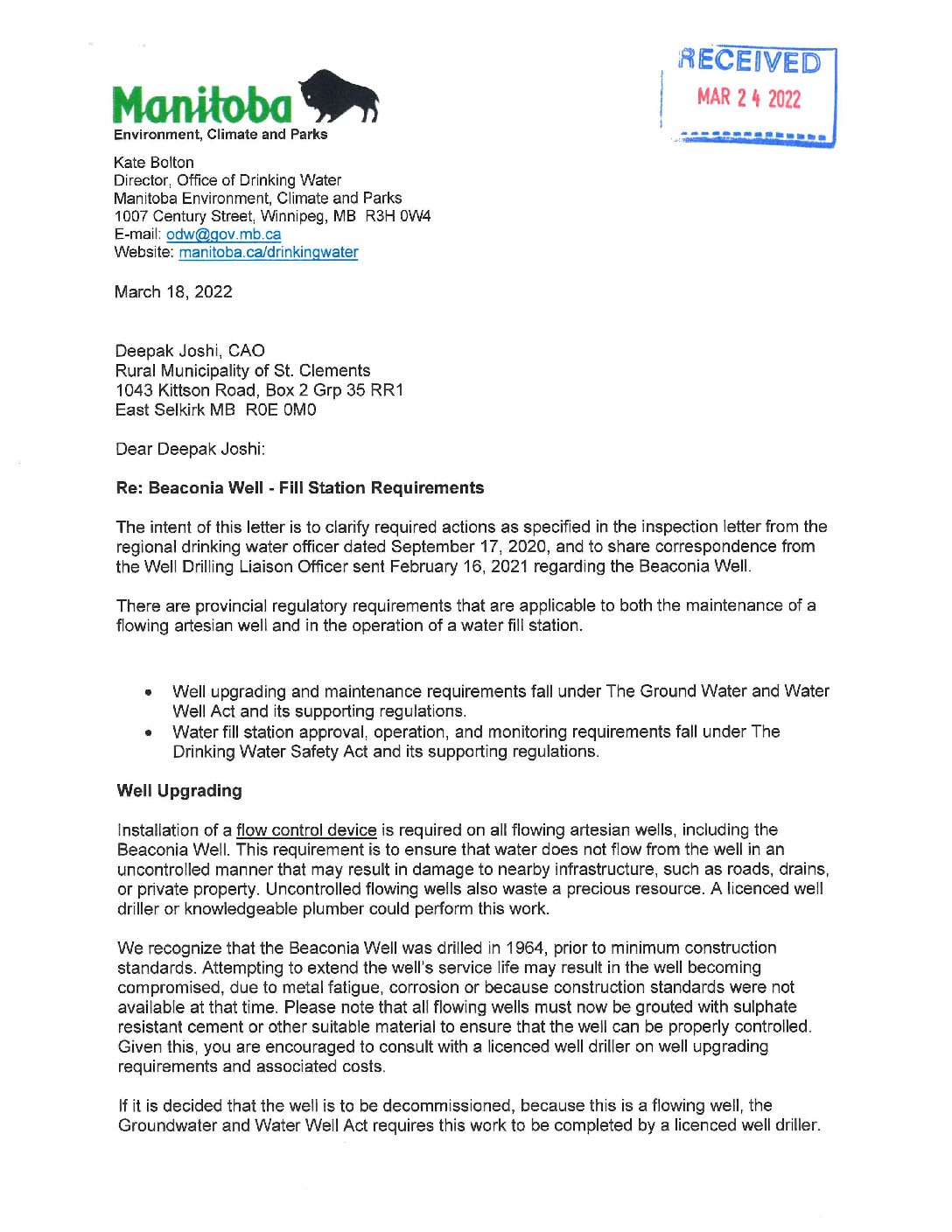
    September 2020The RM is advised that the Beaconia Pail Fill is not meeting regulatory compliance with the Groundwater & Well Water Act of Manitoba. The RM is directed to bring the free flowing artesian well under control by any means necessary in order to comply with the Groundwater and Water Well Act and associated regulations.
    2021Options were considered to gain compliance with regulations:
    1. Decommission well and direct users to alternate location such as the Truck Fill opening Fall of 2022 at the East Selkirk Water Treatment Plant
    2. Upgrade the well to allow flow control to satisfy regulations which requires significant upgrades to prevent freezing of the well. Options include Self Draining pipe similar to existing station, Modern Jug/Pail Fill station
    3. Upgrade to Truck/Bulk Fill station and adopt a user pay system to cover significant capital investment and maintenance costs
    Late 2021/Early 2022Public Works assessed costs of investment, maintenance and asset/financial risk for the various options. The recommendation was made to Council that the most economical and low risk option was to decommission the well and direct users to an alternate water source such as the new Truck Fill station opening at the East Selkirk Water Treatment Plant in Fall 2022. Council resolved that maintaining the public’s access to water free of charge at this specific location is preferred. In addition, Council directed administration to develop a communication plan to advise residents of this requirement to comply with the provincial act and regulations.
    2025The matter became more urgent when the Province issued a formal Well Sealing Order on February 18, 2025. The order required the existing Beaconia Well to be decommissioned by September 2, 2025.
    The RM continued to explore alternatives to outright loss of the service. On February 26, 2025, it requested that the Province permit the Beaconia facility to be converted to a non-potable water source, accompanied by flow control, signage, notices and regular testing.
    The Province subsequently advised that:
    – the September 2, 2025 deadline remained in place at that time;
    – conversion to a non-drinking-water fill station was not an acceptable regulatory solution;
    – a new compliant public water system could be developed; and
    – a newly constructed pail-fill system could potentially operate without continuous disinfection, subject to regulatory approval and a demonstrated history of satisfactory bacteriological water quality.
    At that point, the RM moved away from trying to keep the old well in service and focused on building a new, compliant artesian well and pail/jug-fill system at the Beaconia site.
    2026Work on the new compliant water system continued through the spring and summer of 2026.
    Where possible, the RM kept the existing well available during construction so residents would
    not lose access while the replacement system was being completed.
    On June 24–25, 2026, the Beaconia facility was temporarily closed to allow electrical service to be connected to the new well building. The work included trenching, electrical installation, backfilling and site restoration and represented another significant step toward commissioning the replacement facility.
    Current Status:
    On August 13, 2026, the new Beaconia Pail Fill Station was open, approved and available for residents to use.
    The new Beaconia Pail Fill Station is approved and available for public use; and the former well is permanently decommissioned as part of the transition to the new compliant system. This is a significant milestone. The RM has replaced an aging, non-compliant well with a new
    compliant public pail-fill system, while keeping local water access in Beaconia and meeting the Province’s decommissioning order.

    FAQ

    What was the cost of this project?

    When was the Beaconia Well installed?

    The Beaconia Well was installed in 1964 as a residential well prior to establishment of well construction standards.

    When did the Groundwater and Water Well Act come into effect?

    The Groundwater and Water Well Act and Regulations came into effect on January 1, 2017 which included many changes to the way in which flowing artesian wells are allowed to be drilled and maintained.

    Has the water been tested regularly over the years?

    Yes, because the well is registered with the Office of Drinking Water as the Beaconia Public Pail Fill, bacterial analysis is performed quarterly (every three months), while the ODW performs general chemistry analysis every five years.

    Why might the water need to be treated now?

    To date and under the current license from the Office of Drinking Water, the Beaconia Pail Fill has been permitted to operate without disinfection. With the proposed updates required to meet Groundwater & Well Water Regulations under Provincial Legislation, we would need to apply to the Office of Drinking Water for a permit to alter or construct. At that time, disinfection requirements would be reviewed and ultimately be up to the Director and Medical Officer of Health as to whether or not disinfection could be required.

    Disinfection falls under the Drinking Water Safety Act and the Office of Drinking Water’s approvals branch.

    Disinfection requirements

    20(1) Every

    (a) public water supplier; and

    (b) semi-public water supplier in relation to a water system for which disinfection is required by the regulations;

    must disinfect the water system’s water supply in accordance with the regulations.

    Why do we have to make changes now when it has been there and worked fine for us for years?

    The Office of Drinking Water visited the Beaconia Pail Fill to conduct their annual compliance inspection on September 9, 2020. The ODW noted and instructed that the RM of St. Clements had to follow requirements to bring the free flowing artesian well under control. The well as it had been operating is no longer acceptable according to Provincial Legislation and is in contravention of the Groundwater and Water Well Act.

    Our Water & Waste Coordinator verified the Groundwater and Water Well Act regulates artesian well conditions and requires the land owner to take all necessary actions to ensure water does not flow from the well in an uncontrolled manner.

    Who regulates the well?

    The Province of Manitoba regulates this well. Under the Groundwater & Well Water Act, enforced by the Groundwater Management department, and the Drinking Water Safety Act, enforced by the Office of Drinking Water we have various requirements to satisfy. The Office of Drinking Water licensed the Beaconia Well as a Pail Fill Semi-Public Water System (which was renewed and a copy of the licence can be found below under “Where is the copy of the physical valid licence to continue to operate?“). The contravention is under the Groundwater & Well Water Act and as such the Well Drilling Officer for Manitoba Environment, Climate and Parks has directed us to take action to achieve compliance once it was brought to our attention in September 2020.

    Where is the physical order?

    Receiving an order from senior levels of government does not have to be in the form of an order but can be ordered to comply via communication through email or verbal instruction. We were given direction verbally to comply, or ordered, when the ODW visited the Beaconia Pail Fill to conduct their annual compliance inspection in 2020. Following the February 28, 2022 inspection we received an official direction to make several mandatory changes to the well.

    You can view the letter below that was sent by regulators stating that changes must be made, including a flow control device and a disinfection process to ensure the safety of the water for human consumption.

    The RM will not willfully ignore instructions related to specific legislation and an order is typically the last course of action when the authority having jurisdiction (in this case the Province) feels all other means to comply have failed. We have been working with senior levels of government in order to comply with legislation and make sure the service can be provided in some fashion for the community.

    A helpful example to help understand the situation would be, take our Protective Services Officer. They enforce our already existing By-Laws. When someone is in contravention with a By-Law, the officer would give that person direction to comply with existing By-Laws and would then work with that person to comply.

    This applies to the situation with the Beaconia Well. The bodies that regulate the well have notified us that we are in contravention with their already existing regulations in the Groundwater & Well Water Act, which we have outlined the exact sections that are applicable, and we are working with the regulating bodies to bring it into compliance.

    The issues around the Beaconia Well are clearly identified through the Groundwater & Well Act and Well Standards Regulation and specific excerpts from both can be found below:

    Well Standards Regulation

    Flow control device

    27(1)

    A person constructing a flowing artesian well must install a flow control device that is capable of

    (a) stopping the discharge of water from within the well casing; and

    (b) withstanding the freezing of water in the well casing.

    Flow control device — owner responsibility

    27(2) After the requirements of subsection (1) have been fulfilled, the owner of the land on which the well is located must ensure that the requirements of clauses (1)(a) and (b) continue to be met.

    The Groundwater and Water Well Act

    Property owner to ensure no uncontrolled flow

    39(3)      An owner of land on which a flowing artesian well or a flowing artesian test hole is located must ensure — except during construction and any period after construction necessary for the person who performed the construction to bring the flow of water under control — that water does not flow from the well or test hole in an uncontrolled manner.

    Well and site maintenance

    42           Every owner of land on which a well is located must ensure that

    (a) the upper open end of the well casing is covered in a manner that prevents any substance that could adversely affect the quality of water in the well from entering the well;

    (b) the land around the well is satisfactorily mounded to promote drainage away from the well;

    (c) the well and the well site are maintained in a manner that prevents any substance that could adversely affect the quality of water in the well from entering the well;

    (d) the well is protected from flooding, if it is located in an area where it may be subject to damage by flood water;

    (e) the well is protected at the ground surface from physical damage; and

    (f) the prescribed requirements for maintaining the well and well site are satisfied.

    Well construction and well sealing orders

    53(1)

    The director or a well drilling officer may make a well construction order or a well sealing order under this section if he or she reasonably believes that

    (a) an existing well or test hole, or a well or test hole under construction,

    (i) is, may be or may become a risk to human health or safety,

    (ii) is adversely affecting, or may adversely affect, any property, or any groundwater or other feature of the environment,

    (iii) is, or may be, a contaminated well, or

    (iv) does not comply with the requirements of this Act; and

    (b) an order is necessary to investigate, prevent, remedy, mitigate or otherwise deal with the matter.

    Example:

    A better example to help understand the situation would be, take our Protective Services Officer. They enforce our already existing By-Laws. When someone is in contravention with a By-Law, the officer would give that person direction to comply with existing By-Laws and would then work with that person to comply.

    This applies to the situation with the Beaconia Well. The bodies that regulate the well have notified us that we are in contravention with their already existing regulations in the Groundwater & Well Water Act, which we have outlined the exact sections that are applicable, and we are working with the regulating bodies to bring it into compliance.

    What is needed to be done to bring the well to meet provincial requirements?

    Water wells and their construction, maintenance and decommissioning are all regulated by the provincial Government Groundwater & Well Water Act and regulations. We were given direction from the Province to comply and have been working with the Office of Drinking Water and Manitoba Environment, Climate and Parks. For the well to meet provincial requirements, the following is required:

    1. Control flow of the artesian well. Currently the flow is uncontrolled as the water is continuously flowing out onto the ground which violates the Groundwater and Water Well Act. A flowing artesian well must have a flow control device that is capable of stopping the discharge of water from within the casing, as well as be able to withstand the freezing of water in the well casing. This is to ensure that water does not flow from the well, like in its current state, which could cause damage to nearby infrastructure such as roads, drains and/or nearby homes. This could be achieved by the various options that were considered:
      • Decommission well and direct users to alternate location such as the Truck Fill opening Fall of 2022 at the East Selkirk Water Treatment Plan
      • Upgrade the well to allow flow control to satisfy regulations which requires significant upgrades to prevent freezing of the well. Options include Self Draining pipe similar to existing station, Modern Jug/Pail Fill station
      • Upgrade to Truck/Bulk Fill station and adopt a user pay system to cover significant capital investment and maintenance costs
    1. Threaded connection be removed due to possible contamination issues with hoses. Hoses connected to a water supply cannot be left on the ground in the dirt, possibly surrounded by animal waste. When people place these hoses in their tanks to fill up, bacteria on the hose can be washed into the water. Hoses connected to water systems are required to have an air gap and this is not being achieved at this time
    2. Installation of a chlorination system is required at water fill stations to ensure that water being supplied and stored by residents carries a disinfectant residual to ensure safety of the water for human consumption

    Where is the copy of the physical valid licence to continue to operate?

    Click below to view the operating licence from the Province of Manitoba:

    There are hundreds of other free flowing artesian wells in the Province?

    There is a map generated by the Province of Manitoba to indicate areas where to expect artesian conditions to help inform licensed drillers of the risks so they are prepared ahead of time to address artesian conditions. Artesian groundwater conditions can become extremely costly to remedy if drillers are not prepared when they set out to drill a well. Therefore, this map does not indicate that artesian conditions are allowed to free-flow, the map simply indicates where to expect artesian conditions in order to prepare and prevent them from free flowing.

    There are however a small handful of free flowing artesian wells that are facing the same requirement as us, to be either sealed or have the flow controlled. If there are known artesian wells, the Province of Manitoba would appreciate being informed. You can contact them directly by email at groundwater@gov.mb.ca or by phone 204-945-6959.

    All levels of government in Canada are taking the actions necessary to protect our groundwater resources, and for the Beaconia Well that means restricting the free flow to ensure the aquifers resource remains intact.

    Why do you want to shut down the Beaconia Well?

    A reminder that at this time, no decision has been made by Council on upgrades at the Beaconia Well. Council is in agreement that maintaining the public’s access to water free of charge at this specific location is preferred, however there are high level estimates and risks with the options to bring the Beaconia Well to compliance.

    All options are being considered to allow for the following:

    • Compliance with Provincial Acts – satisfy provincial regulations ordered for flow control
    • Costs – consider options necessary to conduct minimal upgrades to keep costs low
    • Accessibility to community – strive to maintain the public access to water free of charge for the community

    What are the costs involved?

    At this time, there are a lot of variables and we will be able to obtain more clarity once the inspection of the well is completed and we know what the upgrade options are. At that time, details of the calculated costs as well as community responses will be shared in a final report to Council and with the community.  

    Why can’t our taxes that we pay cover any costs?

    Only 46% of total municipal revenues collected from taxes go towards running the RM. 22% of revenues are from transfers and reserve Funds, and 32% is raised through grants and fees.

    For example, $338.55 of your municipal taxes goes towards Transportation Services (think snow clearing, dust control, grading, hard surfaced roads) that is budgeted at $4,515,620.00.